

Open the drawer under your hob. There’s a frying pan lying diagonally because the handle is too long to point straight back. The saucepan sits beside it because its handle catches on the rim when you try to stack the two. Now try finding a spot for the lid.
In a compact Singapore HDB kitchen, that’s the strongest case for GreenPan Click Chef. Detach the handle and compatible pan bodies can nest in one stack. A frying pan and saucepan can share a spot in the drawer, with the handle tucked alongside. That can free up room for the lid or a pot you already use.
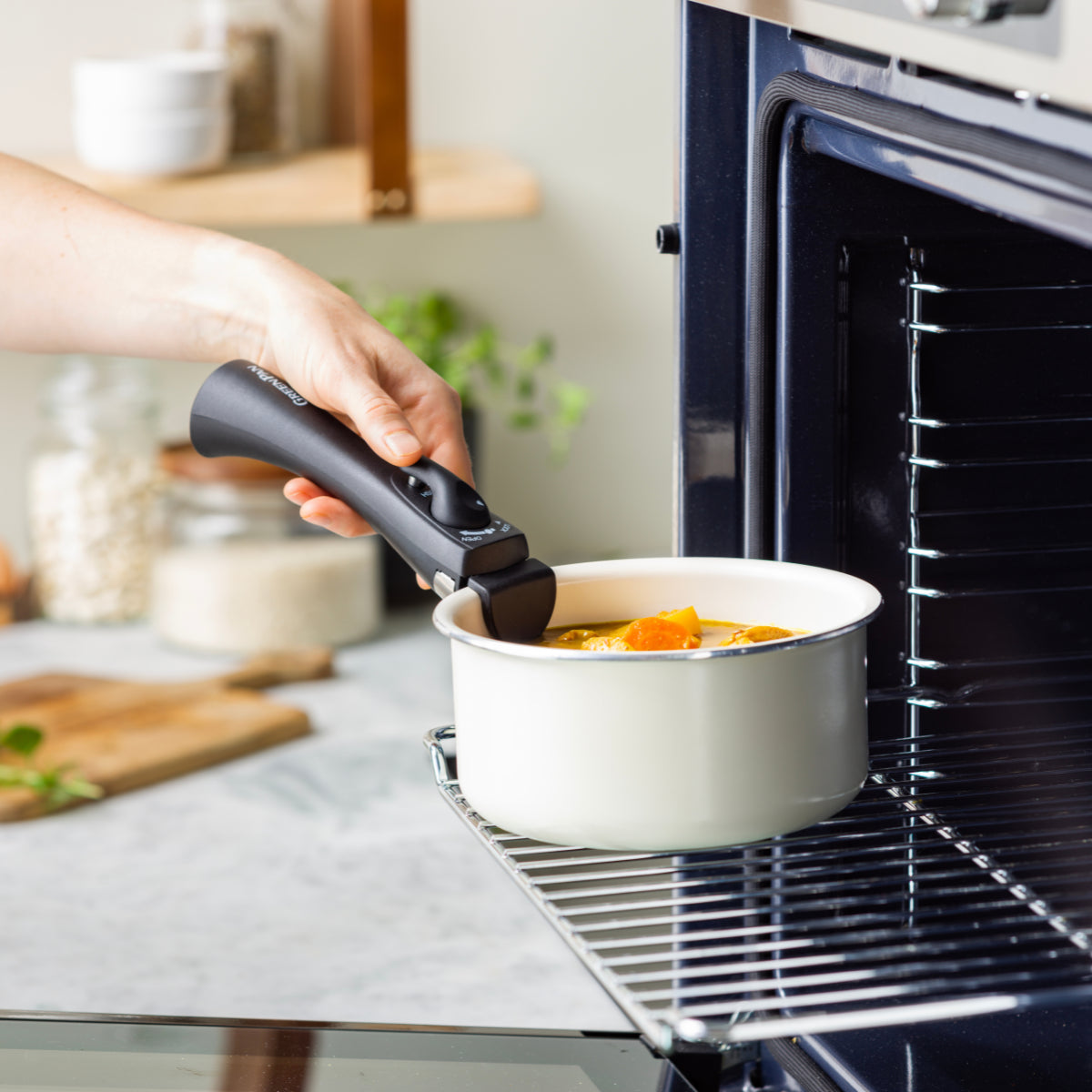
What space does the detachable handle actually save?
With fixed handles, every pan needs enough room from its far rim to the tip of its handle. Turning one diagonally can make it fit, but it also takes up the corner you might have used for something else. With Click Chef, the widest pan body determines the width of the stack. The detached handle can go in the gap beside it.
The benefit is clearest if your pans already fit through the drawer opening and the handles are what stop you from stacking them. If the drawer is too shallow for the pan bodies and lids, taking the handles off won’t fix that. HDB kitchen layouts and cabinet fittings vary, so measure the drawer you have.
Try the one-drawer test before you buy
- Measure the usable opening, depth and height. Measure inside the drawer where the pans will sit. Check the narrowest point and the clearance when the drawer closes.
- Mark out the widest pan. If you’re considering the 26 cm Click Chef deep frypan, use a 26 cm paper circle as a rough starting point. Check the actual outer dimensions before buying. The rim still needs room to clear the drawer.
- Give the lids and handle a spot. Leave room for a protector between stacked pans. If the lid knob makes the stack too tall, measure a spot beside it or in a separate lid rack.
What a win looks like. You can close the drawer and lift out your usual frypan without moving two other pieces. The space you reclaim should be big enough for something you use, like a lid or the saucepan you keep on the counter.
Start with the two pieces you already reach for
For a household that regularly fries eggs or fish and heats soup or cooks noodles, start by comparing a 20 cm deep frypan and a 20 cm saucepan. Check how the exact pieces stack and which lid and handle options come with them. If the bigger job is browning several portions at once, consider the 26 cm deep frypan and check its footprint first.
HeyHommies lists some Click Chef pieces with pan-only and handle bundle options. If this is your first piece, check that your selection includes the compatible handle. If you regularly need to lift two hot pans at the same time, a second handle may be worth keeping in the drawer. Follow the product instructions and confirm the handle is locked before lifting.
If the handles are what keep your cookware spread across two shelves, replacing the pieces you use most is where Click Chef can make the biggest difference.
Read the Kitchen Notes guide to choosing kitchenware in Singapore


